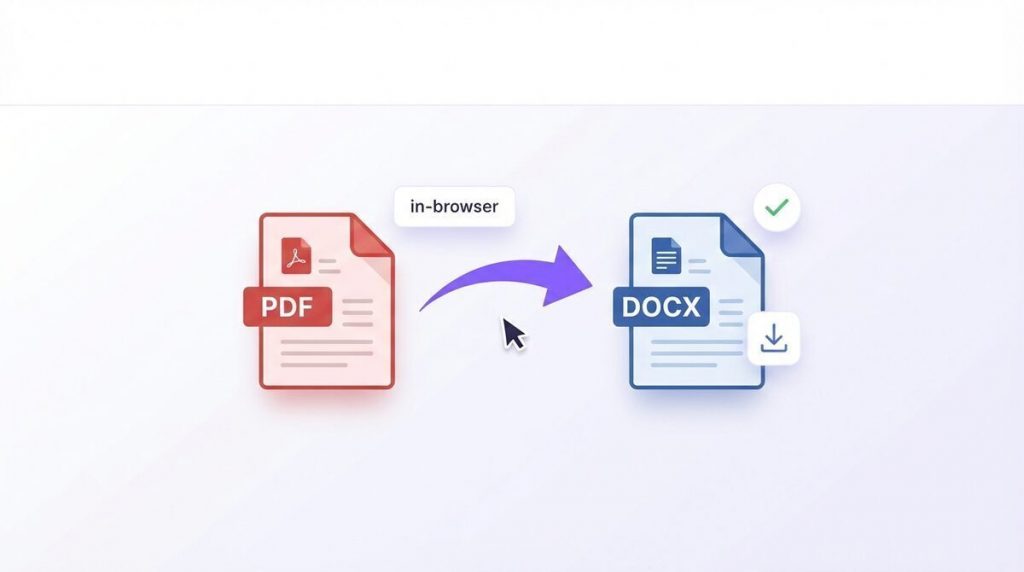
Learning how to convert PDF to Word is one of the most useful skills for anyone who works with documents, because a PDF is built for viewing while a Word file is built for editing. The moment you need to fix a typo, update a price, reuse a paragraph, or reformat a contract, you need that content back in an editable .docx — and you need it fast.
The good news: you can convert PDF to Word for free, in seconds, without installing anything or handing your documents to a stranger’s server. In this guide you’ll learn three reliable ways to do it — a free browser tool, Microsoft Word, and Google Docs — plus how to keep your formatting intact, what to do with scanned PDFs, and how to keep your files private the whole time.
Everything here works on Windows, Mac, Chromebook, iPhone, and Android. Let’s get your PDF back into an editable Word document.
Why Convert a PDF to Word?
A PDF (Portable Document Format) is designed to look the same everywhere — the same fonts, spacing, and layout on any screen or printer. That reliability is exactly what makes a PDF hard to edit. Word documents, by contrast, are made to be changed.
Here are the most common reasons people need to convert PDF to Word:
- Editing text — fix typos, update numbers, or rewrite whole sections.
- Reusing content — pull paragraphs, tables, or headings into a new document.
- Filling in templates — a form or contract you received as a PDF but need to complete.
- Collaboration — tracked changes and comments are far easier in Word.
- Repurposing — turn a finished report into a draft you can adapt for next quarter.
Whatever your reason, the goal is the same: move the words out of a locked-down PDF and into a document you can actually work with. The three methods below cover every situation.
PDF vs Word: What Actually Changes When You Convert
To get the best results, it helps to understand what happens under the hood when you convert PDF to Word. A PDF stores each piece of text as a glyph placed at an exact coordinate on the page — it knows where every character sits, but not that a block of text is a “heading” or that a group of cells is a “table.” It’s closer to a printout than a document.
A Word file is the opposite. A .docx is a structured document made of paragraphs, styles, lists, and tables that reflow when you type. So when you convert PDF to Word, a converter has to reverse-engineer structure from position: grouping characters into words, words into lines, and lines into paragraphs, then guessing where headings and tables belong.
That reconstruction is why simple, text-based PDFs convert almost perfectly, while design-heavy pages need a little clean-up. Knowing this, you can pick the right source file and set realistic expectations — and you’ll rarely be surprised by the result.
Method 1: Convert PDF to Word Free in Your Browser (Fastest)
The quickest way to convert PDF to Word for free is a browser-based tool that never uploads your file. With PDFLove’s free PDF to Word converter, the entire conversion runs inside your browser tab — your document is read, its text extracted, and a Word file built right on your own device. Nothing is sent to a server, so there’s nothing to leak.
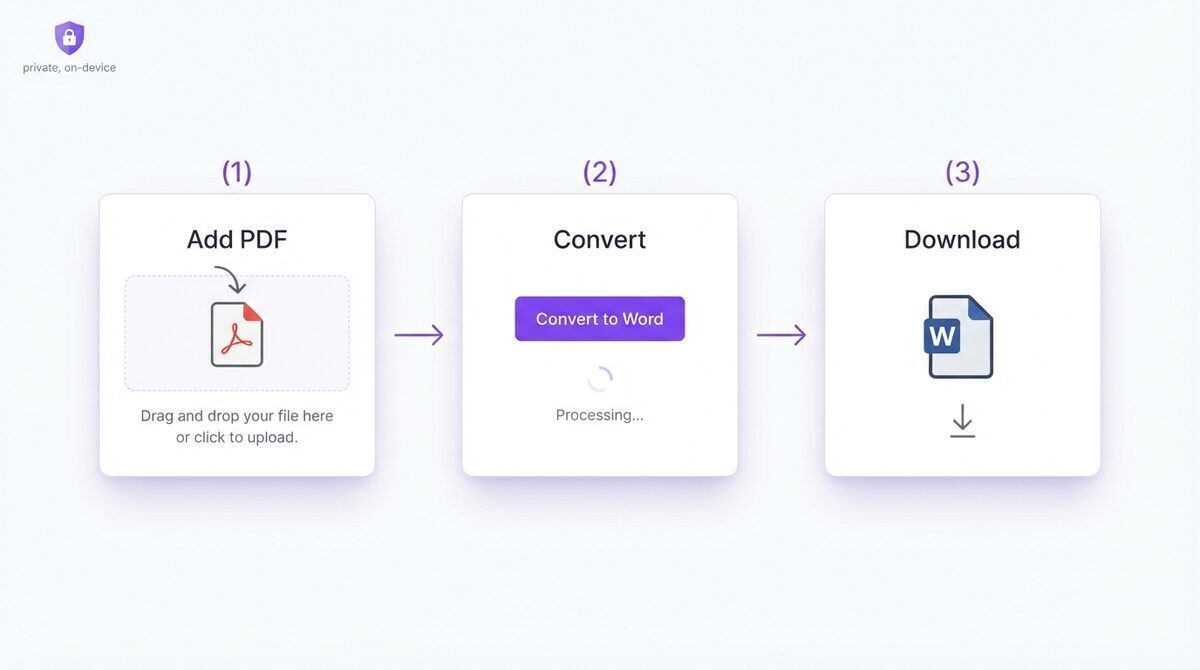
Here’s how to convert PDF to Word in three easy steps:
- Open the tool. Go to the free PDF to Word converter in any modern browser.
- Add your PDF. Drag the PDF onto the page, or click to browse and select it. The file stays on your computer.
- Convert and download. Click “Convert to Word”, wait a second or two, then download your editable .docx file.
That’s it — no account, no email, no watermark, and no daily limit. Because the work happens locally, conversion is usually instant even for long documents, and it keeps running even if your connection drops mid-task.
This method is ideal when you want speed and privacy together. It’s also the most cross-platform option: it works the same whether you’re on a work laptop, a school Chromebook, or a phone. If you regularly need to convert PDF to Word, bookmark the tool so it’s one click away.
Method 2: Convert PDF to Word Using Microsoft Word
If you already have Microsoft Word installed, it can open a PDF and convert it into an editable document directly. Microsoft calls this “reflow”, and it works well for text-heavy PDFs.
- Open Microsoft Word.
- Click File > Open and browse to your PDF.
- Word shows a message that it will convert the PDF into an editable document. Click OK.
- Wait for Word to reflow the content, then edit as normal.
- Save the file as .docx with File > Save As.
Microsoft explains the reflow behavior in its own support documentation. The trade-off is that complex layouts — multi-column pages, heavy tables, or lots of graphics — can shift around during conversion. For simple documents, though, opening a PDF in Word is a dependable way to convert PDF to Word without any extra software.
Note that this method requires a paid Microsoft Office/365 license, and it only runs on the desktop version of Word — the free web version of Word cannot convert a PDF the same way. If you don’t have a license, jump back to Method 1 or try Google Docs below.
Method 3: Convert PDF to Word with Google Docs (Free)
Google Docs is another free way to convert PDF to Word, and it’s handy if you already live in Google Drive. It works by importing the PDF as an editable Google Doc, which you then download in Word format.
- Go to drive.google.com and sign in.
- Click New > File upload and choose your PDF.
- Right-click the uploaded PDF and choose Open with > Google Docs.
- Google converts the text into an editable document (formatting may be simplified).
- Choose File > Download > Microsoft Word (.docx).
Google Docs is genuinely free and works on any device with a browser. The downside is that your PDF is uploaded to Google’s servers to be processed, and layout accuracy varies — expect some clean-up on documents with columns or tables. If privacy is a priority, an on-device tool that never uploads is the safer route to convert PDF to Word.
How to Convert PDF to Word on iPhone and Android
You don’t need a computer to convert PDF to Word. Because the browser method runs entirely on your device, you can do it from a phone in the same three steps.
On iPhone or iPad
- Open Safari (or Chrome) and go to the free PDF to Word converter.
- Tap the upload area, then pick your PDF from Files, iCloud Drive, or your email.
- Tap convert, then save the .docx to Files or share it straight to another app.
On Android
- Open Chrome and go to the converter.
- Tap to browse and select the PDF from your storage or Google Drive.
- Convert and download the Word file to your device.
This is perfect for quick edits on the go — say a contract lands in your inbox and you need to tweak a clause before a meeting. You can convert PDF to Word on your phone in under a minute, with no app install required.
How to Convert PDF to Word Without Losing Formatting
The most common frustration when people convert PDF to Word is formatting that shifts — misaligned columns, broken tables, or fonts that don’t match. No converter is perfect, because a PDF stores positioned text rather than the structured styles Word uses. But you can get much closer to a clean result with a few habits.
- Start with a text-based PDF. If the PDF was exported from Word, Google Docs, or a similar app, its text is selectable and converts cleanly. Scanned images are a different case (see below).
- Keep layouts simple. Single-column, text-heavy documents convert most reliably. Expect to tidy up multi-column magazines or design-heavy brochures.
- Fix styles after converting. Reapply Word’s built-in Heading styles so your document is easy to navigate and reformat.
- Rebuild complex tables. For critical tables, paste the data into a fresh Word table rather than trusting the auto-conversion.
- Check fonts. If a font isn’t installed on your system, Word substitutes a similar one — set your preferred font after conversion.
With realistic expectations, you’ll spend seconds converting and only a minute or two polishing — far faster than retyping a document by hand.
How to Convert Multiple PDFs to Word at Once
If you regularly need to convert PDF to Word in bulk — a folder of invoices, a stack of reports, a semester of lecture notes — doing them one at a time still adds up quickly with a fast browser tool, because each conversion is instant and there’s no upload wait.
For the smoothest batch workflow:
- Keep the tool open in a tab and convert files back to back — no reloads, no re-logging in.
- Rename as you download so your Word files don’t overwrite each other in the downloads folder.
- Group similar documents (all contracts, all statements) so your clean-up style is consistent across the set.
- Combine first if needed. If several PDFs belong in one document, merge the PDFs before you convert, so you end up with a single Word file.
Because everything runs on your device, you can convert PDF to Word for an entire folder without ever exposing those documents to a server — a real advantage when the batch contains client or financial records.
Converting a Scanned PDF to Word (Use OCR First)
There’s one type of PDF that won’t convert to editable text no matter which tool you use: a scanned document. A scan is really just a picture of a page, so there’s no text to extract — only pixels.
To convert a scanned PDF to Word, you first need OCR (Optical Character Recognition), which “reads” the image and turns it into real, selectable text. Run the scan through a free OCR tool to add a text layer, then convert PDF to Word as usual. If you try to convert a scanned PDF without OCR, you’ll get an empty or garbled document — a sure sign the source was image-only.
A quick way to check whether your PDF is scanned: open it and try to select a sentence with your cursor. If the text highlights, it’s a real text PDF and will convert cleanly. If nothing selects, it’s a scan and needs OCR first.
Common Problems When You Convert PDF to Word (and How to Fix Them)
Even with the right method, you may hit a snag. Here are the issues people run into most often, and the fix for each.
The Word file is empty or full of gibberish
Your PDF is almost certainly scanned or image-only. Run it through OCR first, then convert PDF to Word again.
Tables and columns are misaligned
Complex layouts don’t map perfectly onto Word’s structure. Rebuild important tables manually, or accept a quick clean-up pass for multi-column pages.
The PDF is password protected
A converter can’t read a locked PDF. Remove the password with a free unlock tool (when you have the right to do so) and then convert.
Fonts look different
The original font may not be installed on your device, so Word substitutes one. Select all and choose your preferred font after converting.
The file is too large or slow
An on-device converter handles big files without an upload wait. If a server-based tool times out, switch to a browser tool that processes locally.
When to Keep Your File as a PDF Instead
Converting isn’t always the right move. Sometimes the PDF is exactly the format you want, and turning it into Word would do more harm than good. Keep the PDF when:
- You’re sharing a final version. PDFs look identical on every device and can’t be edited by accident — ideal for contracts, resumes, and invoices you’re sending out.
- Layout is the point. Brochures, certificates, and design-heavy pages rely on precise positioning that Word won’t preserve perfectly.
- You only need small tweaks. To fill a form, add a signature, or drop in a note, it’s faster to edit the PDF directly than to convert PDF to Word and back.
- File integrity matters. For legal or archival documents, the fixed PDF format is often required.
A good rule of thumb: convert PDF to Word when you need to rewrite content, but keep the PDF when you only need to view, sign, or share it. If you just need light edits, PDFLove’s other free tools let you sign, annotate, and fill forms without converting at all.
Why PDFLove Is the Free, Private Choice
Most online converters ask you to upload your PDF to their servers. For a shopping list that’s fine — but contracts, invoices, medical records, and IDs are a different story. Once a file leaves your device, you’re trusting someone else’s security and privacy policy.
PDFLove takes a different approach. Every tool runs 100% in your browser, so when you convert PDF to Word your document never leaves your computer. There’s no upload, no cloud storage, and no account — which also means there’s nothing for a data breach to expose. On top of that, PDFLove is genuinely free, with no watermarks, no page limits, and no file-size caps.
You also get a full toolkit in one place. Beyond converting, you can merge, split, compress, sign, and protect PDFs — all with the same private, on-device processing. It’s the convenience of an online tool with the privacy of desktop software.
PDFLove vs Other PDF to Word Tools
How does an on-device converter compare with the alternatives?
- vs. server-based online tools: similar speed for small files, but no upload, no privacy risk, and no daily conversion limit.
- vs. Microsoft Word: no paid license required, and it runs on any device including Chromebooks and phones.
- vs. Google Docs: comparable price (free), but your files aren’t uploaded to a third party.
- vs. desktop converters: nothing to install or update, yet the same on-device privacy.
For most people, a free browser tool is the sweet spot: fast, private, and available everywhere.
Frequently Asked Questions
How do I convert PDF to Word for free?
Open a free browser-based converter like PDFLove’s PDF to Word tool, add your PDF, and click convert. You’ll get an editable .docx in seconds — no sign-up, no watermark, and no upload.
Is it safe to convert PDF to Word online?
It depends on the tool. Server-based converters upload your file, which is risky for sensitive documents. A tool that processes on your device — where the PDF never leaves your browser — is much safer.
Will I lose formatting when I convert PDF to Word?
Simple, text-based PDFs convert cleanly — paragraphs, headings and lists usually come across intact. Complex layouts are where things drift: multi-column pages tend to flatten into a single column, tables can lose their cell borders, and text boxes or graphics may land in the wrong place. That happens because a PDF records where each character sits on the page rather than that it belongs to a paragraph or a table, so the converter has to infer the structure. For the cleanest result, reapply Word’s built-in heading styles instead of formatting by hand, rebuild any table your reader actually needs to edit, and check the first and last line of each page for stray headers and footers.
Can I convert a scanned PDF to Word?
Yes, but you need OCR first. Run the scan through an OCR tool to create a real text layer, then convert PDF to Word as normal.
Do I need Microsoft Word installed?
No. A browser converter or Google Docs lets you convert PDF to Word without Office. You only need Word installed if you want to use its built-in Open-a-PDF method.
Can I convert PDF to Word on my phone?
Yes. Because a browser tool runs on your device, you can convert PDF to Word on iPhone or Android in the same three steps — open the tool, add the PDF, download the Word file.
Is there a limit to how many PDFs I can convert?
With PDFLove there’s no daily limit, no page cap, and no file-size restriction — convert as many PDFs as you like, free. Many free converters stop you at around 30 pages per file, or a handful of conversions a day, and then ask you to subscribe. PDFLove doesn’t need those limits, because the work happens in your browser instead of on a server we pay to run. The only real ceiling is your own device’s memory, so a very large scanned document will take longer on an old phone than on a laptop.
Can I convert PDF to Word and keep images?
Browser-based text converters focus on extracting editable text, so images may not carry over. If you need the pictures too, convert PDF to Word for the text and add the images back in Word, or export the pages you need as images separately.
Conclusion
You now have three dependable ways to convert PDF to Word for free: a fast, private browser tool, Microsoft Word’s built-in reflow, and Google Docs. For most situations — especially anything sensitive — an on-device converter gives you the best mix of speed, simplicity, and privacy.
Whichever route you choose, remember the two habits that make every conversion smoother: start from a text-based PDF (run a scan through OCR first), and do a quick clean-up pass on complex layouts afterwards. With those in mind, you can convert PDF to Word in seconds and spend your time editing rather than retyping.
Before you send anything to a random online converter, remember the privacy trade-off: sensitive documents deserve a tool that processes everything on your own device. When you convert PDF to Word with an on-device tool, your file is never uploaded, stored, or seen by anyone but you — and you still get an editable Word document in seconds, completely free.
Ready to turn that locked-down PDF into an editable document? Convert your PDF to Word for free with PDFLove — no sign-up, no uploads, and your files never leave your device.